Field Ascend is field service management software with tool tracking, calibration management and LOLER inspection records built in as standard. Instead of running a separate spreadsheet or standalone tool register alongside your FSM platform, you manage jobs, engineers and tool compliance in one system — included in every plan from £10 per user per month.
30-day free trial · Full access to all features · Cancel anytime
Most contractors track their own tools and test equipment in a spreadsheet, a shared folder of scanned certificates, or — worst case — nowhere at all. When a calibration lapses or a LOLER thorough examination expires, nobody notices until an auditor asks or an engineer turns up on site with a tool that's out of tolerance.
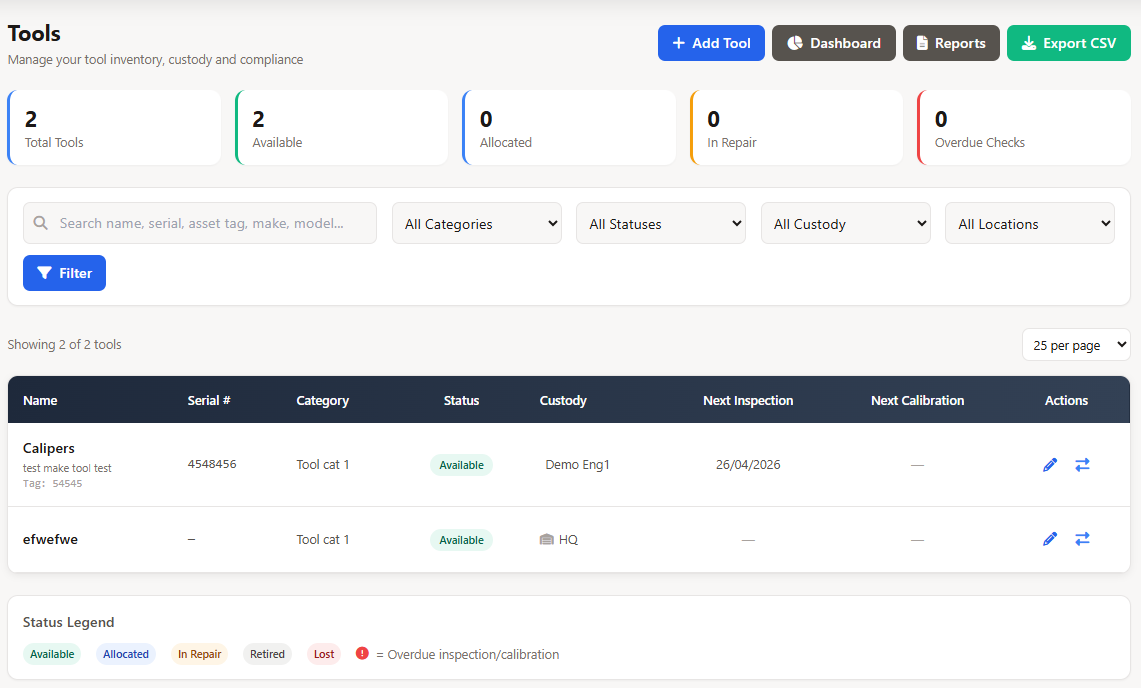
Field Ascend's tool register sits inside the same platform you already use for job scheduling, PPM and invoicing. Every tool gets a record with serial number, unique asset tag, make, model, supplier, purchase cost, condition, photo and current custody location. No separate login, no CSV exports between systems, no version-control headaches.
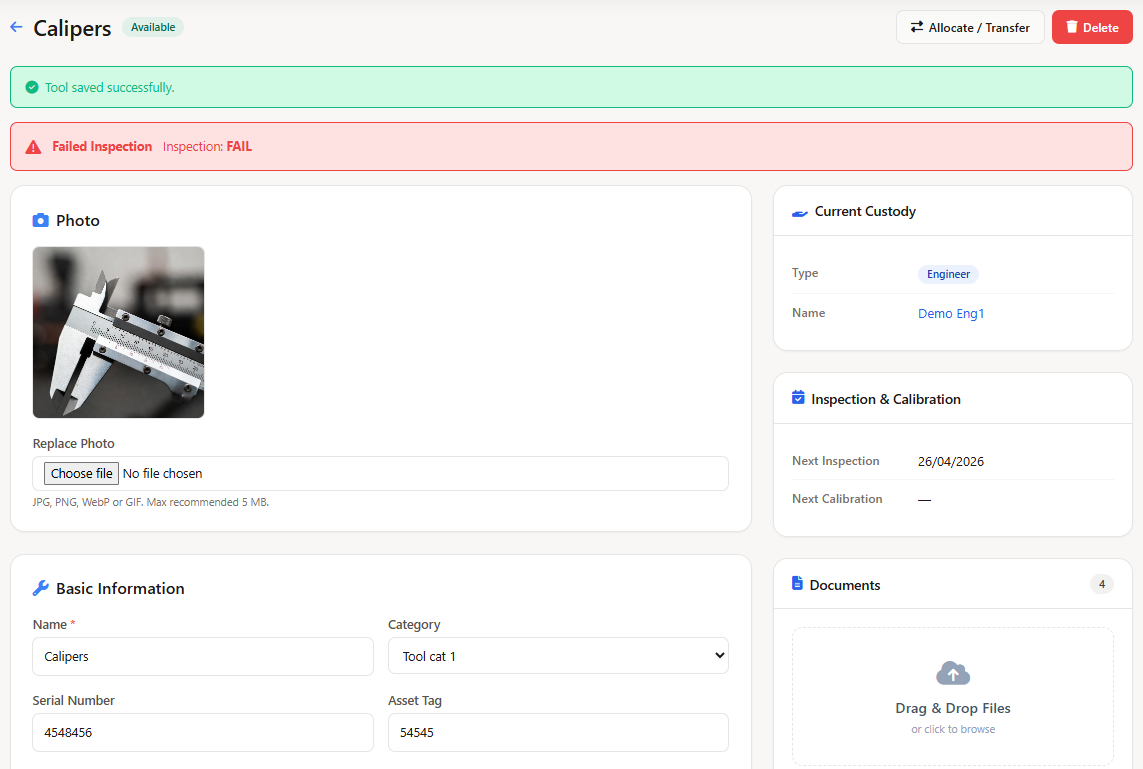
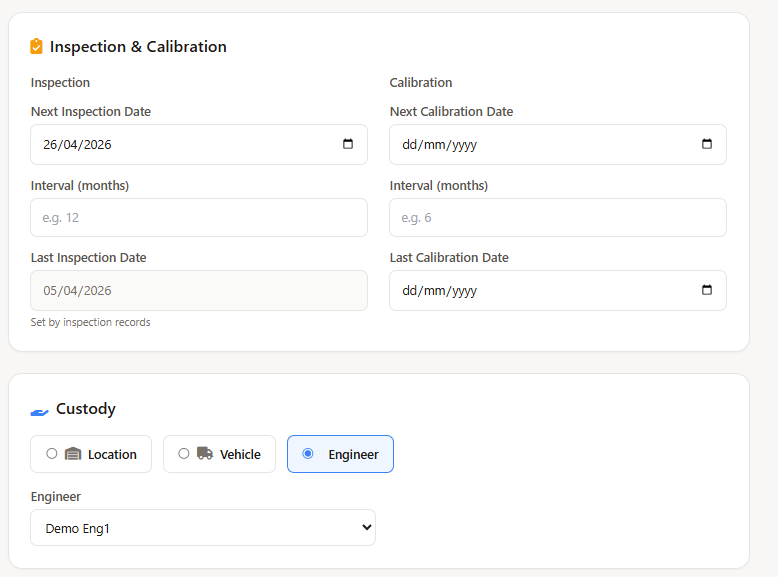
Each tool in Field Ascend carries two independent compliance tracks: inspection (covering LOLER thorough examinations, PAT testing records and general safety checks) and calibration (covering calibration certificates for instruments, gauges and testing kit). Both have their own interval, due date and history — because a torque wrench that's been PAT-tested still needs its calibration certificate, and they're due on different cycles.
When an engineer or administrator logs an inspection or calibration, they record the date, result (pass, fail or conditional), inspector name and optional notes. Calibration certificates and LOLER (1998) thorough examination reports attach as documents directly against the record. Field Ascend then automatically recalculates the next due date from the interval you've set — 6 months, 12 months, whatever the regulation or your ISO 9001 quality management system requires.
Configurable alerts fire at 30, 60 or 90 days before an inspection or calibration falls due, so your operations team has time to arrange the work before a tool quietly slips out of compliance. Tools that fail inspection can be marked as quarantined, pulling them out of the available pool until the problem is resolved and a non-conformance report (NCR) or corrective action is closed off.
Field Ascend tracks tool custody across three location types: named storage locations (warehouse, tool store, office), vehicles (linked to your fleet register), and individual engineers. Every change — allocate, transfer, return, send to repair, retire, report lost — is logged with who made the change, when, and from where. That gives you a complete tool audit trail without any manual paperwork.
Engineers see their allocated tools directly in the Field Ascend mobile app. If a tool is on their person or loaded in their van, it appears in their "My Tools" list with calibration status, next inspection date and attached documents. With the right permissions they can log inspections and upload certificates from the field — even when working offline in basements, plant rooms or rural areas with no mobile signal. Everything syncs when connectivity returns.
This is engineer tool allocation that works in practice, not just on a whiteboard. When an ops manager needs to recall a specific tool for recalibration, they check the register, see which engineer has it, and arrange the handover — rather than phoning round the team to find it.
This is the section that matters most if you're evaluating FSM software with tool management. In a two-system setup — one platform for jobs, another for tool compliance — the scheduler has no idea whether the engineer's insulation tester is in calibration or whether the lifting gear passed its last thorough examination. The dispatcher allocates the job, the engineer drives to site, and the compliance gap is discovered too late.
Because Field Ascend's tool tracking and job scheduling share the same database, the system can flag or block a job allocation when a required tool is out of calibration, quarantined after a failed inspection, or overdue for a LOLER check. The dispatcher sees the warning at the point of scheduling — before the engineer leaves the depot. That single integration point eliminates a category of compliance failures that spreadsheets and standalone tool registers simply cannot catch.
For contractors working under PUWER (1998) obligations, this is not a nice-to-have. It is the practical difference between "we have a tool register" and "our scheduling system enforces tool compliance automatically." Calibration due date alerts stop tools silently drifting out of tolerance. Quarantined tools are pulled from the available pool. And every decision is logged in the tool audit trail, ready for an auditor or a quality manager running an ISO 9001 internal audit.
If you're shopping for job management software with tool tracking, you've probably been quoted for an FSM platform and a separate tool management system — or you're already running them side by side. That means two logins, two subscriptions, two sets of data that never quite agree with each other, and a gap between your scheduling team and your compliance records that only gets wider as you grow.
Field Ascend is contractor software with calibration management, LOLER records, PAT testing logs, custody tracking and QMS form templates built directly into the same platform that handles your jobs, PPM scheduling, quoting and invoicing. There is no add-on module to purchase, no enterprise tier to qualify for, and no integration to maintain. It is included in every plan from £10 per user per month.
That is the value proposition in one sentence: you were about to buy FSM software and a separate tool tracking system, and Field Ascend does both in one, at no extra cost.
Engineers, tools, jobs, PPM schedules and invoices all live in the same database. No syncing, no exports, no conflicting versions.
Tool tracking is included in every Field Ascend plan. No module fees, no enterprise gate, no per-tool charges. See pricing.
Because tools and jobs share one system, the scheduler can enforce calibration and inspection rules at the point of allocation — not after the engineer is on site.
Field Ascend has two distinct modules that sound similar but serve very different purposes. The Tools module (this page) tracks your contractor's own internal tools and test equipment — the calipers, multimeters, torque wrenches, PAT testers, insulation testers, pressure gauges, ladders and lifting gear that your engineers carry and use day to day. It covers custody, calibration, LOLER thorough examinations, inspection scheduling and document storage for your kit.
The equipment and asset tracking module is for tracking your customer's equipment that you maintain under contract — boilers, lifts, HVAC plant, fire alarm panels, electrical distribution boards and everything else installed at the customer's site. That module covers serial numbers, service history, defect logging, QR code scanning, warranty tracking and PPM check sheets tied to specific assets.
Both modules are included in every Field Ascend plan. They work alongside each other but track fundamentally different things: your tools vs your customer's assets. If you need both (most maintenance contractors do), you get both out of the box.
Any field service business where engineers carry calibrated instruments, certified lifting gear or regulated test equipment will benefit from having tool tracking built into their FSM software. The specific compliance requirements vary by trade, but the operational pattern is the same: you need to know which tools each engineer has, whether those tools are in date, and what happens when they're not.
The Tools dashboard gives operations managers a live overview without digging through individual records. Tile stats show total tools in the register, how many are in use, how many have overdue inspections and how many have overdue calibrations. Lists surface upcoming and overdue deadlines ranked by urgency. Charts break down your tool estate by category (Power Tools, Lifting Gear, Test Equipment) and by custody type (warehouse, vehicle, engineer) so you can spot imbalances at a glance.
The reports tab goes deeper with five filterable views: inspection history, movement audit trail, allocation by engineer, full inventory export and document register. Every view supports CSV export, so your quality manager can pull whatever they need for an ISO 9001 management review or a client audit pack without asking you to run a query.
Email alerts are available for tenants that enable notifications. A scheduled process checks all tools across your account and sends calibration due date alerts and inspection due date alerts to the relevant administrators before deadlines pass — configurable at 30, 60 or 90 days out.
For contractors operating under ISO 9001 or similar quality management frameworks, tool compliance is not an isolated task — it sits inside a wider system of non-conformance reports, corrective actions, inspection records and document control. Field Ascend supports this by letting you attach any document type to a tool record: calibration certificates, thorough examination reports, QMS form templates, inspection checklists, supplier correspondence and non-conformance report (NCR) documents.
When a tool fails inspection, the process is: mark the tool as quarantined (it drops out of the available pool), log the failure with notes and photos, attach the NCR or corrective action document, and route the tool for repair or disposal. The tool's movement history, inspection log and attached documents form a complete traceability record — exactly what an auditor expects to see.
Documents upload via drag-and-drop (single or multi-file) and store securely in the cloud. Engineers with the right permissions can view and download documents from the mobile app, so a LOLER thorough examination certificate is available on site without phoning the office. File types supported include PDF, images, Word and Excel — covering the full range of QMS form templates most contractors use.
Field Ascend's built-in tool tracking covers every tool and piece of test equipment your engineers carry — from torque wrenches and PAT testers to insulation resistance testers and pressure gauges. Each tool gets a register entry with serial number, asset tag, make, model, purchase cost, custody location, and full inspection and calibration history. Documents such as calibration certificates and LOLER thorough examination reports attach directly to the tool record.
Each tool has its own calibration interval (e.g. every 12 months). When an engineer or administrator logs a calibration, Field Ascend records the date, result (pass, fail or conditional), inspector name, and any attached calibration certificate. It then automatically calculates the next calibration due date. Configurable alerts warn you 30, 60 or 90 days before a tool falls out of tolerance, and the scheduler can block job allocation if a required tool is overdue.
Yes. LOLER (1998) thorough examinations are logged as inspections against the tool record. You record the inspection date, examiner name, pass/fail/conditional result, and attach the thorough examination certificate as a document. Field Ascend tracks the next inspection due date automatically based on the interval you set, and alerts you before the deadline so you stay compliant with PUWER (1998) and LOLER requirements.
No — they are separate modules for separate purposes. The Equipment & Asset Tracking module tracks your customer's equipment that you maintain under contract (boilers, lifts, HVAC plant, fire systems). The Tools module tracks your own internal tools and test equipment that your engineers carry day to day — calipers, multimeters, torque wrenches, PAT testers, ladders and so on. Both modules are included in every Field Ascend plan at no extra cost.
Yes. Engineers see all tools allocated to them or loaded on their vehicle directly in the Field Ascend mobile app. They can view tool details, inspection history, calibration status, and attached documents. If they have permission, they can also log inspections and upload certificates from the field — even when working offline in basements, plant rooms or areas with no mobile signal. Everything syncs when connectivity returns.
No. The Tools module is included in every Field Ascend plan from £10 per user per month. There is no add-on fee, no module unlock, and no enterprise tier required. You get tool tracking, calibration management, LOLER records, custody audit trails, and document storage alongside jobs, scheduling, PPM, quoting, invoicing and everything else in the platform.
Yes. Each tool can carry a unique asset tag, and you can print QR code labels that link to the tool's register entry. Engineers scan the QR code to instantly pull up the tool record — serial number, calibration status, custody history, and attached certificates — without manual searching.
Because tool tracking and job scheduling live in the same system, Field Ascend can flag or block a job allocation when a required tool is out of calibration, quarantined or overdue for inspection. The dispatcher sees the warning at the point of scheduling — before the engineer leaves the depot — rather than discovering the problem on site. This is the practical benefit of having FSM software with tool management built in rather than running two separate systems.
Start your 30-day free trial with full access to tool tracking, calibration management and every other feature.
Start Your Free Trial