Last updated: April 23, 2026
What is electrical contractor software? Electrical contractor software is the operating system for dispatch, work orders, inspection scheduling, mobile technician updates, quoted remedials, and invoice handoff. For commercial teams, electrical dispatch software is especially important because the office has to assign the right electrician by skill, location, availability and priority while keeping site history, inspection notes and completion evidence connected. Field Ascend is positioned as the commercial electrical contractor choice at SMB price for teams that need fit-out support, maintenance contracts, fault finding, and multi-site service work.
The strongest pages on this keyword often lean either residential or enterprise. Commercial electrical contractors in the 5 to 50 technician range usually need something in the middle: a connected system that can manage fit-outs, ongoing service contracts, inspection scheduling, and estimating-adjacent workflows at a price that can still be budgeted before the sales process starts.
If that is your business shape, also review scheduling and dispatching, work order management, and field service software for small business so the electrical use case stays connected to the wider platform decision.
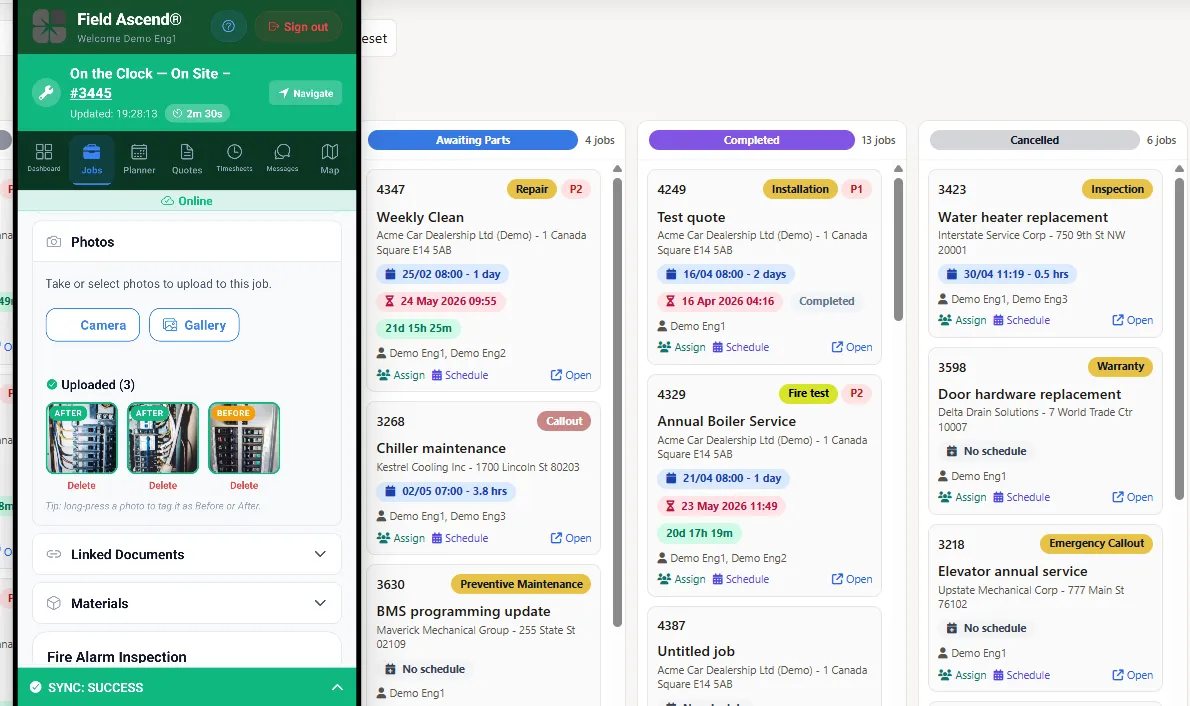
Electrical dispatch software helps contractors assign the right electrician to the right job based on availability, location, skill, job priority and site history. Field Ascend helps electrical contractors schedule jobs, dispatch technicians, update work orders from mobile, capture job evidence and keep quotes, invoices and reporting connected.
For a broader platform view, see electrical field service software and software for electrical contractors in the U.S. feature set.
Electrical dispatch software helps office teams assign electricians by skill, location, and availability, then keep each job connected to the right work order. For commercial electrical operations, dispatch has to support both urgent callouts and planned work while preserving site details and service history for the field team.
Match fault finding, inspections, maintenance work, and fit-out tasks to electricians using job details, location, and current availability.
Manage urgent callouts and planned electrical work in the same workflow so dispatch changes stay visible to office and field teams.
Send job details to mobile technicians, track job status from office to field, and keep site history, evidence, quotes, and invoices connected.
For the wider dispatch workflow, see electrical dispatch software. For the job record behind each visit, see electrical contractor software workflows.
Commercial electrical software should reflect a different operating reality from residential electrician software. Residential work is often faster-turn, homeowner-driven, and simpler from a site-history perspective. Commercial electrical contractors usually need deeper control around quoted projects, inspection records, maintenance contracts, site access, and multi-property client structures.
| Workflow question | Residential electrical software | Commercial electrical contractor software |
|---|---|---|
| Typical work mix | Homeowner repairs, one-off service calls, smaller installs | Fit-outs, ongoing maintenance contracts, inspections, quoted remedials, fault finding, and multi-site service work |
| Typical customer | One homeowner, one address, short service history | Office managers, retailers, industrial operators, property managers, and commercial estates |
| Office need | Fast job booking and homeowner communication | Work order depth, estimate follow-up, maintenance scheduling, compliance logs, and better coordination across teams |
| Best fit | Residential electrician businesses | Commercial electrical contractors with office plus field staff |
The main point is not that residential tools are bad. It is that a commercial electrical contractor should be careful about buying from a page written for a different service model.
Accepted quoted work needs to move from estimating or proposal stage into scheduling, dispatch, and field execution without losing scope detail.
Ongoing job site visits, inspection schedules, and recurring service obligations need to be visible alongside reactive work, not hidden under the next urgent callout.
Commercial electrical jobs often need stronger record-keeping around outcomes, defects, follow-ups, and evidence than a simple appointment app can provide.
That mix of requirements is why the software needs to connect more than just the schedule. The office should be able to see what was estimated, what has been accepted, what has been dispatched, and what came back from the job site. The supporting workflows include preventive maintenance software for recurring service contracts, scheduling and dispatching, work order management, and CMMS software for the maintenance-heavy angle.
A commercial electrical job should move through one connected operating flow: Request → work order → assign technician → mobile job → check-in → evidence/test notes → complete → invoice-ready. That flow matters whether the job is fault finding, an inspection visit, quoted remedial work, a maintenance contract visit or commercial fit-out work.
A customer reports a fault, books an inspection, approves remedials or requests work under a maintenance contract.
The office creates a work order with customer, job site, equipment, estimate, access and priority context attached.
The dispatcher assigns the right electrician by skill, location, availability, priority and service commitment.
The technician receives the job on the mobile app with site history, inspection details and required evidence.
Arrival and job status update the office without a phone call, giving dispatchers a live view of progress.
Photos, notes, signatures, readings, inspection outcomes and remedial findings are captured against the work order.
The electrician closes the work with follow-ups, defects and customer confirmation captured in one place.
The office receives a cleaner record for billing, reporting and any next-step estimate or remedial handoff.
It should. Commercial electrical contractors often live in the gap between estimation and service execution. A remedial estimate is accepted, but the office still has to rebuild the job in a separate system before the team can schedule it. That duplication creates delays, drops context, and increases the chance that the field team arrives without the right scope detail.
The better model is to keep estimating-adjacent work, quoted remedials, dispatch, work orders, and field completion inside one connected operating flow. That does not mean every electrical contractor needs a giant project ERP. It means the system should be able to move accepted work into live operations without forcing the office to re-enter the same job.
This matters most on fit-outs, recurring service work, and small-to-mid commercial projects where one team may be estimating, another dispatching, and another delivering the job site work. The more often that handoff happens, the more valuable the connected workflow becomes.
An electrician scheduling app can show appointments, but a commercial electrical contractor usually needs more than a calendar. Electrical service dispatch software connects the appointment to the work order, technician availability, site history, inspection requirements, quoted remedials, mobile updates and invoice handoff.
| Capability | Electrician scheduling app | Electrical dispatch software |
|---|---|---|
| Calendar or planner | Shows appointments | Shows jobs, technicians, status, priority and dispatch decisions |
| Work order context | Often limited notes | Connected work order, site history, equipment, estimate and customer details |
| Inspection and remedials | May need manual follow-up | Inspection evidence, findings and remedial handoff stay on the job record |
| Mobile updates | Basic job notification | Check-ins, photos, notes, signatures, test notes and completion status |
| Billing handoff | Often separate admin step | Completion record moves toward invoice-ready status |
The best electrical contractor dispatch software depends on your team size, work mix and service model. For small and mid-sized commercial teams, these are the practical features to check before buying:
A clear board for today’s jobs, urgent work, unassigned tasks and technician load.
Assign electricians by certification, experience, location, workload and availability.
Move urgent jobs quickly without losing track of what was displaced.
Send job details, site history, equipment and instructions to the technician in the field.
Capture site evidence and customer sign-off directly against the work order.
Keep inspection notes, findings, follow-ups and supporting evidence attached to the job.
Turn inspection findings and quoted remedials into scheduled work without rebuilding context.
Give the office and technicians a full view of previous visits, issues and access notes.
Bring time, notes, materials, evidence and sign-off back into the office for billing.
Look for pricing that works for small and mid-sized electrical contractors before a long sales process starts. Field Ascend publishes pricing for this reason.
Field Ascend publishes U.S. pricing at $13 per user per month.[1] For many commercial electrical contractors, the key buying decision is fit and workflow coverage: whether dispatch, work orders, mobile updates, evidence capture, quotes, and invoices stay connected without adding unnecessary complexity.
| Platform | Public pricing signal | 10-user / 10-technician annual context |
|---|---|---|
| Field Ascend | Published at $13 per user / month | $1,560 / year for 10 users[1] |
| Generic request-pricing platforms | Commonly quote-led pricing and longer sales process | May suit teams that require heavier rollout and procurement |
| Calendar-only dispatch tools | Often lower complexity but narrower workflow depth | Can work for very small teams with limited process needs |
That table is not a feature-by-feature attack. It is a budget-shape comparison. Commercial electrical contractors often need serious workflow coverage, but they do not all need the same buying motion or the same cost structure.
This page is built for commercial electrical contractors that need practical dispatch and job execution workflows without enterprise-level rollout complexity.
Field Ascend is designed for teams that want electrical contractor software with dispatch, work orders, fit-out and remedial workflow support, maintenance visibility, and office-to-field coordination at a price a 5 to 50 technician business can assess quickly.
Electrical dispatch software helps electrical contractors schedule jobs, assign electricians, send job details to the field, track job progress and keep the office updated as work is completed.
The best fit is usually a system that gives small and mid-sized electrical contractors dispatch, work orders, inspection records, mobile updates and billing handoff without enterprise complexity. Field Ascend is built for that practical commercial workflow.
Field Ascend helps office teams assign and manage electrical jobs based on job details, technician availability, site requirements and operational priorities, with mobile work orders keeping technicians connected in the field.
Yes. A mobile app for electrical contractors lets electricians receive job details, work order history, site notes, inspection requirements and safety context, then send back check-ins, photos, notes, signatures and completion details.
Yes. Electrical service dispatch software should support inspection visits, fault finding, quoted remedials, preventive maintenance contracts and commercial fit-out work, while keeping findings and evidence connected to the work order.
Pricing varies by platform and plan. Field Ascend publishes U.S. pricing at $13 per user per month.
Commercial electrical software usually has to support fit-outs, ongoing maintenance, inspection records, fault finding, site history and multi-site service delivery, while residential tools are more focused on smaller homeowner jobs.
Yes. The right system should keep accepted quoted work connected to scheduling, dispatch, field completion and invoice handoff rather than forcing the office to rebuild the job in a second tool.
https://field-ascend.com/en-us/pricing - published U.S. pricing at $13 per user per month. Accessed April 23, 2026.
If your business needs dispatch, inspections, quoted remedials, and maintenance contract visibility in one system, compare the published pricing and the commercial fit before defaulting to a custom-priced enterprise platform.
Field service software for small business