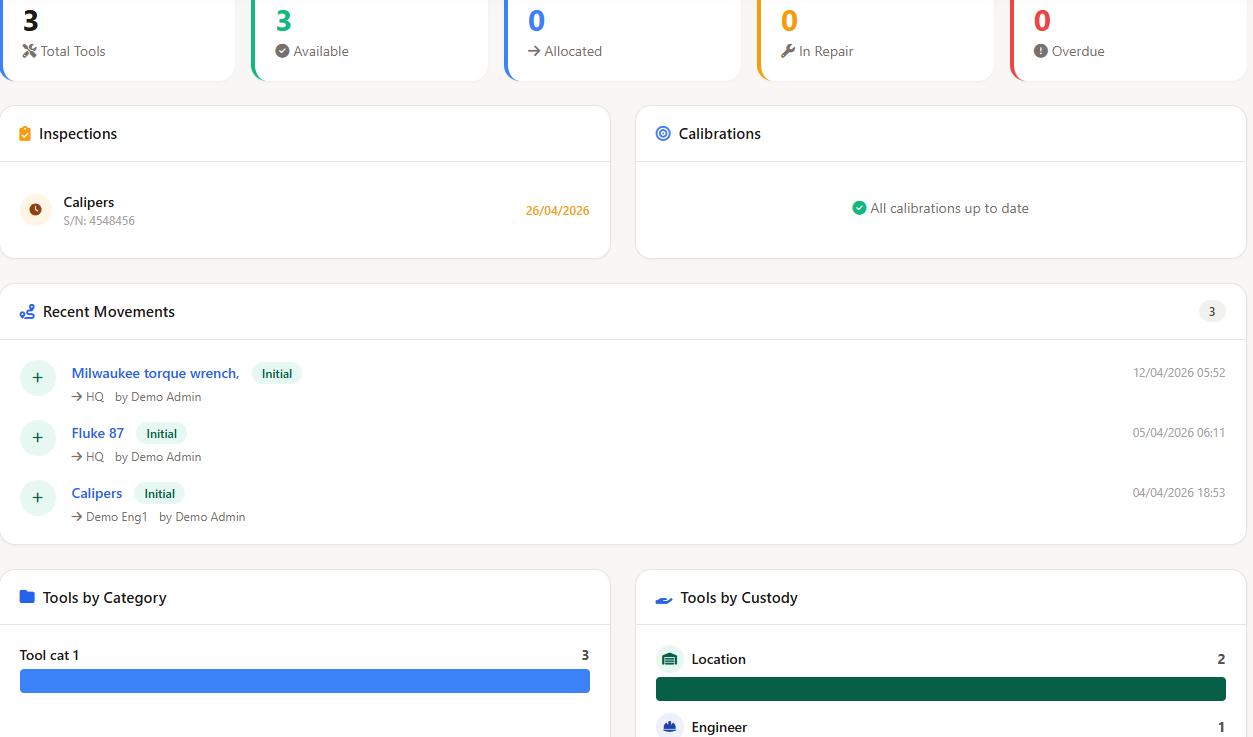
Field Ascend is field service software with tool tracking, calibration management, and OSHA-ready inspection records built into the same platform you use for scheduling, dispatch, and work orders. Instead of running a separate tool crib system alongside your FSM software, you manage jobs, technicians, and tool compliance in one place - included in every plan from $13 per user per month.
30-day free trial · Full access to all features ·
Most contractors shopping for field service management software also need tool tracking software for field service. That usually means buying a separate tool crib management system, maintaining two databases, and hoping they never contradict each other. Field Ascend is FSM software with tool management built into the same database your dispatch, scheduling, and work orders already use.
Your tool register, calibration records, and custody chain share the same database as your job schedule, technician assignments, and customer records. No CSV imports. No sync conflicts. No duplicate data entry between a tool tracking app and your work order software.
Because dispatch and tool compliance share one system, the platform can block a work order assignment when a required tool is out of calibration or quarantined. A standalone contractor tool inventory software package has no idea what jobs are scheduled - it can only send you an email you might miss.
Tool tracking, calibration management, scheduling, quoting, invoicing, and the mobile app are all included from $13/user/month. No per-tool fees. No separate tool tracking subscription to manage alongside your FSM license.
Every tool and test instrument in your fleet gets a digital record that stays with it for life. The register is not a spreadsheet bolted onto the side of your FSM - it is a first-class part of the platform with the same search, filter, and reporting capabilities you use for jobs and customers.
When a technician needs to know whether a Fluke multimeter was last calibrated in March or October, the answer is one search away - not buried in a filing cabinet or a shared drive folder named "Certs 2024."
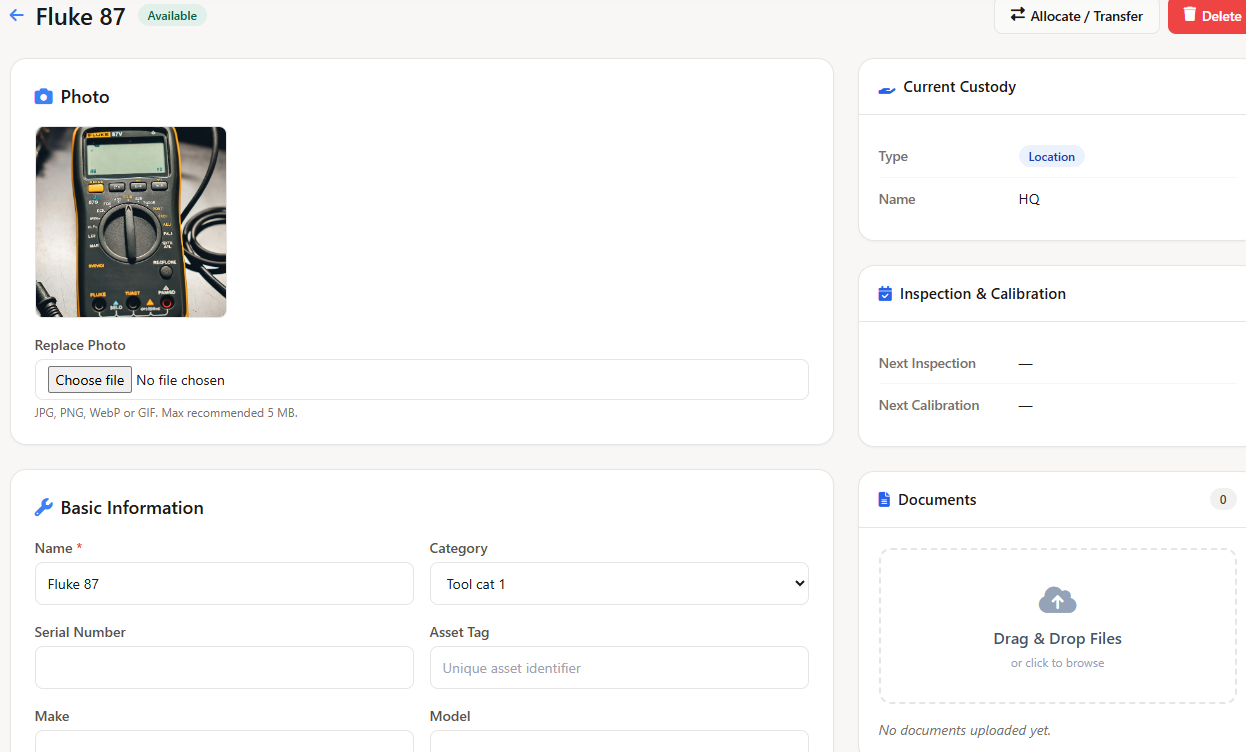
This is the feature that separates work order software with tool tracking from a standalone tool crib system. When dispatch and tool compliance share one database, the system knows which tools are required for a job and whether those tools are currently compliant.
If a technician's torque wrench is overdue for calibration, or a megger has been quarantined after an out-of-tolerance finding, the platform flags the conflict before the work order is dispatched - not after the technician drives to the site and discovers the problem.
No standalone tool tracking software for field service can do this, because it has no visibility into your job schedule or dispatch board.
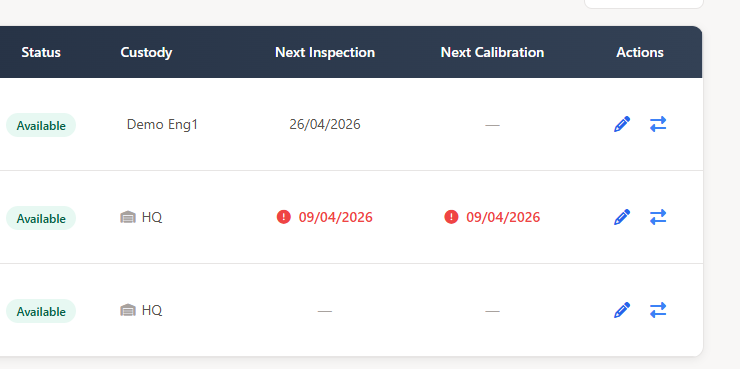
Field Ascend maintains two independent compliance tracks for every tool: calibration and periodic inspection. These are separate because they serve different purposes and often run on different schedules. A torque wrench might be calibrated annually by an ISO 17025 accredited lab, while its physical condition is inspected quarterly by an in-house technician. Both tracks generate their own due dates, alerts, and documentation.
Calibration management covers the accuracy verification side. You set the calibration interval per tool, and the system calculates the next calibration due date automatically. Configurable alerts fire at 30, 60, or 90 days before expiry so your operations team can schedule the recalibration before the tool goes out of compliance. When calibration is completed, the certificate or lab report is attached directly to the tool record. The system supports ISO 9001 and ISO 17025 documentation requirements out of the box.
Periodic inspection covers physical condition, safety, and regulatory compliance. OSHA inspection records for hoisting and rigging equipment fall under ASME B30 standards. Electrical test instruments used on energized circuits must meet NFPA 70E requirements. Fall protection tools need documented inspection before each use. EPA 608 certified tools used in refrigerant recovery carry their own inspection requirements. Field Ascend's calibration management software handles all of these through configurable inspection types and intervals.
When a tool fails inspection or is found out of tolerance during calibration, it can be immediately quarantined in the system. A non-conformance report (NCR) is generated, the tool's status changes to quarantined, and it becomes unavailable for dispatch. The quarantine stays in effect until the tool is recalibrated, repaired, or formally retired. Every action in this chain is timestamped and attributed to a specific user, building the OSHA compliance tool tracking audit trail that regulators expect to see.
This is not a bolted-on compliance add-on. It is built into the same platform where your technicians receive their daily work orders, log their hours, and close out jobs. Compliance data does not live in a separate system that someone remembers to check on Fridays.
Losing track of who has which tool costs contractors thousands of dollars a year in replacement purchases and project delays. Field Ascend tracks tool custody across three location types: warehouse or tool crib, truck or service vehicle, and individual technician. Every custody transfer is logged with a timestamp and the identity of the person who made the change.
From the office, dispatchers and operations managers can see at a glance which tools are in the tool crib, which are loaded on which truck, and which are signed out to a specific technician. The tool crib check-in/check-out workflow means that when a technician picks up a tool for the day, the system records the transfer. When it comes back, the return is logged. If a $3,000 power quality analyzer goes missing, you know exactly who had it last and when.
In the field, technicians use the Field Ascend mobile app to view their assigned tools, check tools in and out, and confirm custody transfers between team members. The app works offline - a technician in a basement mechanical room or a remote site without cell phone signal can still view tool assignments and record changes. Data syncs automatically when connectivity returns. No separate tool tracking app to install and no second login to remember.
The technician tool assignment history becomes part of the tool's permanent record. If you need to know every person who had custody of a particular instrument over the past two years for an audit, the data is there.
These are two different problems, and Field Ascend handles both - but they live in separate modules for good reason.
Tool tracking (this page) manages your contractor-owned tools and test instruments: the things your technicians carry in their trucks and check out from the tool crib. Calibration, custody, OSHA inspection records, and quarantine workflows all apply to your own assets.
Customer equipment tracking manages the equipment your customers own that you service under contract: rooftop HVAC units, elevator systems, boilers, fire panels, generators. That is the CMMS and preventive maintenance module - a separate set of registers, service histories, and maintenance schedules tied to customer sites rather than your own inventory.
Both modules are included in every Field Ascend plan. You do not choose between them or pay extra for one. A facility maintenance contractor who needs to track both their own torque wrenches and their client's chiller fleet uses the same platform for both, with clear separation between "our tools" and "their equipment."
Any field service business where technicians carry calibrated instruments or safety-critical tools benefits from having tool tracking built into their FSM software rather than running it as a separate system.
HVAC and refrigeration contractors rely on manifold gauges, refrigerant recovery machines (EPA 608 certified tools), and combustion analyzers that all require periodic calibration. When a recovery machine's scale is out of tolerance, the work stops.
Electrical contractors depend on multimeters, meggers, thermal imagers, and circuit tracers that must meet NFPA 70E and ANSI standards for accuracy and safety. Sending a technician to commission a panel with an uncalibrated meter is a liability.
Plumbing and mechanical contractors use pressure test gauges, pipe inspection cameras, and leak detection instruments that need regular calibration to produce reliable readings.
Facility maintenance teams manage large inventories of hand tools, power tools, and specialized instruments across multiple buildings. Tool crib management software that connects to their preventive maintenance software for tools means fewer lost items and tighter compliance.
Industrial service contractors working with hoisting equipment, cranes, and rigging gear need ASME B30 compliant inspection records. The tools used to inspect and maintain that equipment (torque wrenches, load cells, dynamometers) need their own calibration tracking.
Tool tracking in Field Ascend covers the full lifecycle of your contractor-owned tools and test instruments. That includes a digital register with serial numbers, asset tags, make, model, purchase cost, and photos. It also tracks custody (who has the tool and where it is), calibration due dates, periodic inspection records, and non-conformance reports when a tool is found out of tolerance. Everything ties directly into your work order and dispatch workflows.
Each tool in the register can carry two independent compliance tracks: calibration and periodic inspection. You set the calibration interval and the system calculates the next due date automatically. Configurable alerts fire at 30, 60, or 90 days before expiry so you can schedule recalibration in advance. When calibration is completed, the certificate or lab report is attached directly to the tool record. The system supports ISO 9001 and ISO 17025 documentation requirements.
Yes. Field Ascend maintains timestamped inspection records, calibration certificates, and a complete audit trail for every tool. When OSHA requires documentation that periodic inspections were performed on hoisting equipment (ASME B30), electrical test instruments (NFPA 70E), or fall protection gear, the records are already in the system. Non-conformance reports and quarantine actions are logged with dates and responsible parties.
Field Ascend tracks tool custody across three location types: warehouse or tool crib, truck or service vehicle, and individual technician. A tool crib assignment means the tool is checked into a central inventory location. A field assignment means it has been checked out to a specific technician or loaded onto a specific truck. The custody chain logs every transfer with timestamps so you always know where a tool is and who had it last.
Yes. Technicians use the Field Ascend mobile app to check tools in and out, view calibration status, and see which tools are assigned to them. The app works offline, so a technician in a basement mechanical room or a remote site with no cell phone signal can still view their tool assignments and record custody changes. Data syncs automatically when connectivity returns.
Tool tracking, calibration management, and all compliance features are included in every Field Ascend plan starting at approximately $13 per user per month. There is no separate add-on or higher tier required. You get tool tracking alongside scheduling, dispatch, work orders, quoting, and invoicing in one platform. A 30-day free trial with full feature access is available. See the U.S. pricing page for details.
Standalone tool tracking software manages your tool inventory in isolation. Field Ascend connects tool tracking directly to your dispatch, scheduling, and work order workflows. That means the system can block a work order assignment when a required tool is overdue for calibration - something a standalone tool crib system cannot do because it has no visibility into your job schedule. You also avoid maintaining two separate systems, two logins, and two data silos.
Start your 30-day free trial and see how tool tracking, calibration management, and dispatch work together in one platform. All features included from day one.
Start Your Free Trial