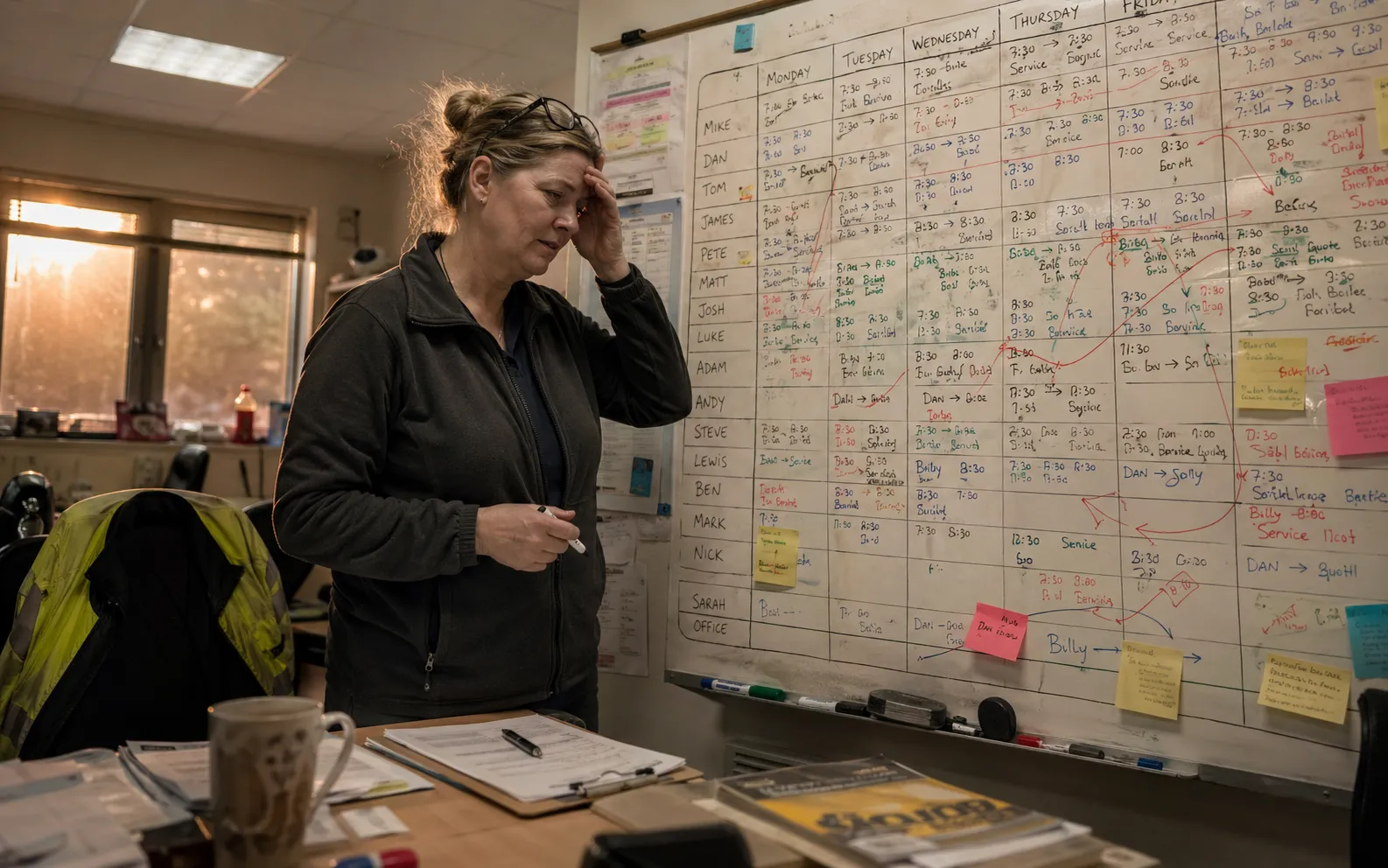
Maria runs operations for a 10-tech commercial HVAC contractor outside Columbus. Not a huge company. Not a one-truck shop either. Ten technicians, two office staff, a steady book of rooftop units, PM contracts, emergency calls, and customers who expect a call-ahead before anyone rolls to site.
On paper, the schedule was full. In the office, it felt like a daily fight. One technician would ghost a work order because the text thread changed after he left the yard. Another would drive 42 minutes across town while a qualified tech was finishing five ZIP codes away. A PM visit would get bumped for an urgent call, then disappear from the spreadsheet until the customer asked why the quarterly service never happened.
Nobody called it a software problem at first. It sounded like a people problem. The dispatcher was tired. The technicians were not checking messages. Customers were sending call-aheads to voicemail. But when Maria put the week under a microscope, the pattern was obvious: the team was losing time because the dispatch system had no single source of truth.
The number that finally got the owner's attention was $84,000. It was not a perfect accounting model, but it was close enough to hurt. Ten techs losing an average of 73 minutes a day to drive-time bleed, rework, call-backs, wrong-site arrivals, and dispatcher reshuffling. At a conservative fully burdened labor and overhead value, that waste became a truck-sized problem by December.
The rough math: 73 minutes lost per technician per day x 10 technicians x 240 working days = 2,920 hours. Even if only part of that time becomes recoverable billable or productive capacity, the annual leak can climb fast. Maria's shop estimated $84,000 in avoidable operational drag.
The whiteboard was not the villain. The handoff was.
The whiteboard had helped the company grow. It was fast, visible, and familiar. The problem was that the board stopped at the office wall. It did not know whether a technician had acknowledged the work order. It did not know if the customer contact had changed. It did not know the site had three rooftop units and a locked loading gate. It could not warn the dispatcher that the afternoon route was now impossible.
That is why replacing a whiteboard with another calendar is not enough. A commercial contractor needs scheduling and dispatch software that connects the board to the mobile workflow, customer site notes, PM schedule, and work order status.
Maria's first useful change was simple: every dispatch decision had to land in one system. If a work order moved, the technician saw it. If a technician updated status, the office saw it. If a PM visit was bumped, it stayed visible instead of becoming spreadsheet archaeology.
The dispatcher got her mornings back
The emotional part of this is easy to miss. Dispatcher burnout is not just "being busy." It is being responsible for every moving piece while nobody has the same information. A technician calls. A customer calls. The owner asks why the urgent work order is still open. The board looks full, but nobody can tell whether it is realistic.
Once the company moved dispatch into a live system, the morning scramble changed. The dispatcher could see open work, assigned technicians, mobile updates, route pressure, and upcoming PM work in one place. She still made judgment calls. She just stopped rebuilding the same truth from texts, voicemails, and spreadsheet tabs.
That is where the fix becomes practical rather than inspirational. The goal is not to remove human dispatching. It is to remove blind dispatching.
The fix costs less than one bad week
The reason this story matters for 10-tech shops is that the software math has become absurd. Some contractors feel stuck between cheap tools that cannot handle commercial field work and enterprise platforms that can run $250-500 per tech per month.
Field Ascend is built for the middle: commercial FSM for contractors who need serious scheduling, dispatch, mobile work orders, GPS visibility, PM scheduling, and invoicing without paying enterprise prices. The published starting point is about $13/user/month, so a 10-tech shop is roughly $1,560 per year before tax. You can compare that directly on the pricing page.
For Maria's kind of shop, the buying question was not "Can software make us modern?" It was sharper: "Can we stop losing truck days to dispatch confusion without signing a $30,000 to $60,000 annual contract?"
The answer starts with a dispatch board the office trusts, a mobile workflow technicians actually see, and route-aware scheduling that keeps drive time from eating the margin. If that is the problem you are trying to solve, start with the commercial scheduling and dispatch software page and compare the workflow section against your current morning.
Stop letting dispatch eat the profit
Field Ascend gives commercial contractors dispatch, work orders, mobile technician updates, PM scheduling, GPS context, and pricing that does not punish growth.
Start your 30-day free trial